@przemer We recently submitted a new proposal that directly addressed the grant council’s previous feedback—specifically a focus on user adoption and increased liquidity on Lisk by expanding our platform. Despite addressing the councils explicit concerns and feedback, the proposal was denied.
This is concerning because we have already demonstrated, with verifiable on-chain metrics, that our project outperforms every other project building on Lisk. Faet Studio has received less funding than other Web3 gaming platforms, such as Powerpals, yet our metrics and technology stack remain objectively superior. Our ERC-20 token and NFTs have more volume, transactions, and liquidity than any other project on Lisk. These are indisputable facts, backed by on-chain data.
Despite outperforming ALL competition, even those that are better funded and supported, we are told that our numbers “are not good enough.”
The proposal includes:
-
A custom UI for minting Character NFTs using FAET tokens.
-
Integration of these NFTs into our already released game, Faet RPG.
-
An entirely new NFT set with built-in rarity, token locking, and the ability to unlock and burn character NFTs to create new characters.
-
Translation support for our RPGMaker plugins, enabling developers in Japan, Korea, and elsewhere to integrate Lisk into their own RPGMaker games with no coding required.
-
Marketing Campaign with ad $2,000 ad spend on x. (That’s 6,000 LSK BTW)
This is a significant milestone: because of Faet Studio, Lisk is the only blockchain integrated with the RPGMaker engine, one of the most widely used engines for Steam game releases.
Despite this, we were told to ask for less funding (as little as 10,000 LSK) than projects like Lucred—a contract that rugpulled, was drained within days, and delivered nothing of substance. The council has yet to explain why Faet Studio, which is actively building and proving results, should be valued below literal scams that stole user and DAO funds.
We also fully detailed how we would achieve our on-chain growth metrics in this proposal. Instead of acknowledging this, the council’s response was simply that “we couldn’t do it.” Meanwhile, other projects with no contracts, no frontends, and no social presence are promoted as “comparable” to our project with a massive and fully functional technology stack built on Lisk.
@Jashdotfi Your analysis of our project is vastly incorrect, and it is crucial to recognize that the numbers you are evaluating us by are simply wrong.
-
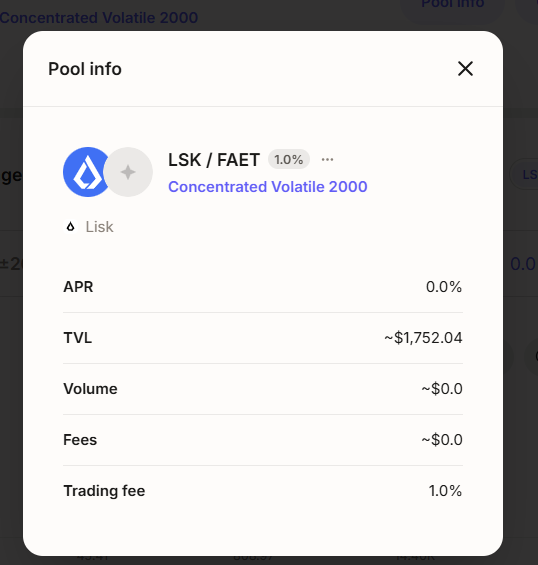
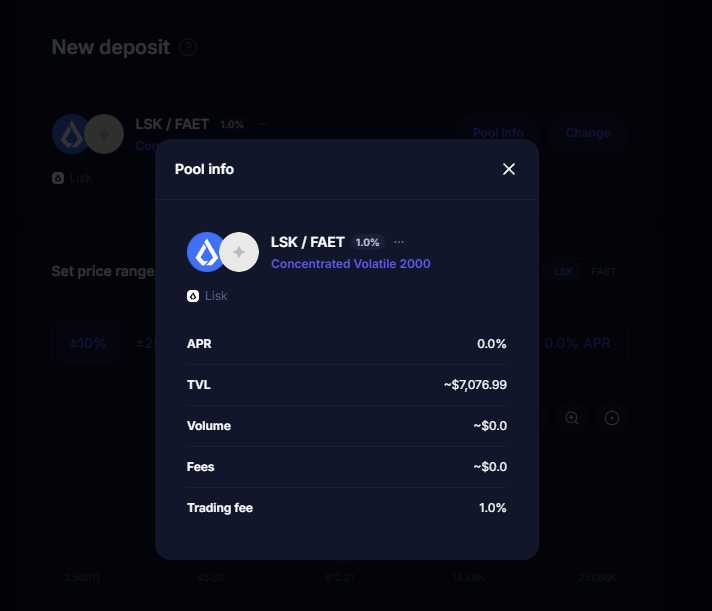
Liquidity Pool TVL: You reported ~$1,000, but our pool has consistently held closer to $7,000 in TVL for weeks as we continue to grow. That’s nearly an order of magnitude off.
-
Staking Contract: You claimed it lost tokens. In reality, you are misinterpreting basic blockchain analytics. Our staking contract has added over 9 million FAET in less than 2 months—an increase of thousands of dollars locked, not a loss.
-
NFT Volume: Yes, our lifetime NFT volume is just under 1 ETH, but the council specifically requested 30-day analytics, since we only completed Season 2 of our grant less than 2 months ago. By that metric, Faet is 50x higher than the next most traded NFT on Lisk (Lisk of Life).
Only after we proved we were #1 in the requested time frame does the comparison suddenly shift to lifetime volume instead. That is a moving of the goalposts and does not reflect good faith valuations.
So, again. I and many in the community are very confused as to why we have been specifically told to request less funding then a project that has been verified as a scam that took all DAO and user funds.
Request for Consistency, Data Corrections, and Reconsideration of Faet Studio Proposal
To the SuperchainEco team and Lisk Grant Council,
We’re asking for three things: consistent standards, corrected analytics, and a fair reconsideration of our proposal.
1) Consistency in evaluation
Faet Studio is being held to stricter requirements than other applicants. For example, the Emergent Markets Founder Residency reportedly requested 120,000 LSK and was paid in full upfront with no milestones required. When Jash asked for KPIs (e.g., estimated TVL), those KPIs were ultimately not attached as milestones—while Faet was required to provide weeks of feedback and measurable KPIs.
Question: Why are projects evaluated with different requirements and metrics, especially when some have no track record on Lisk?
2) Corrections to analytics used to cut our budget
Our requested 120,000 LSK was reduced to 10,000 LSK based on incorrect analytics as stated above.
These are verifiable, on-chain facts. Using incorrect numbers to justify a 90% cut is not a good-faith assessment.
3) A constructive path forward
We’re happy to negotiate a reasonable budget and align on clear, measurable KPIs. If possible, we’d welcome involvement from the Lisk Dev Relations Lead to help define shared milestones and success metrics we can all stand behind.
Our ask
-
Acknowledge and correct the analytics on record.
-
Apply consistent standards across applicants (milestones, KPIs, and review depth).
-
Reconsider our proposal on the merits. Your latest response even confirms our projects position. So, I think we can agree that the councils request for us to ask for LESS then a scam project makes no sense.
-
If budget is still a concern, propose clear milestone gates tied to KPI targets rather than an arbitrary 90% reduction.
We want to build in good faith, transparently, and in partnership with the council. Please let us prove it with consistent rules and agreed KPIs.
Faet Studio looks forward to the grant councils feedback on this subject. We lok forward to submitting a third application but we hope that these concerns are taken into consideration and adjustments are made. Thank you for your time.